
Dr. Kumud R. Jha · Singapore · Doctorate in AI · US Patent Holder View LinkedIn Profile
Content Provenance and the Rise of C2PA
Seven days ago I showed you the mechanics — AI-generated text indistinguishable from human writing, synthetic voices, video of people saying things they never said. The technology to fabricate convincing falsehoods has never been cheaper or more accessible.
Today I want to go one level deeper.
Because the real crisis is not the fakes. The real crisis is that we are losing the shared infrastructure for deciding what is real.
This is not new. But AI has turbocharged it.
Here is the architecture of the problem.
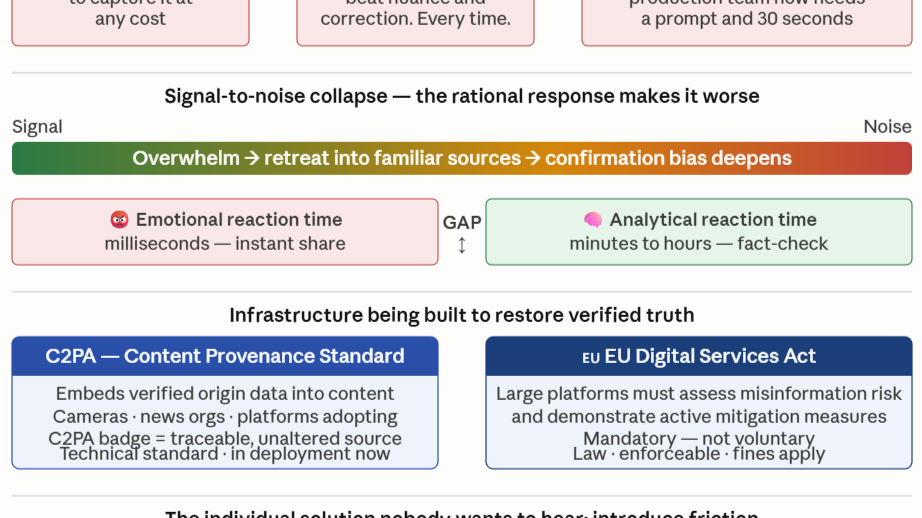
Attention is the scarce resource. Platforms are optimised to capture it. Outrage, fear, and novelty capture attention faster than nuance, correction, or complexity. So the algorithm — not any individual bad actor — systematically amplifies the emotionally charged over the factually careful.
AI lowers the cost of producing emotionally charged content to near zero. What once required a production team and a budget now requires a prompt and thirty seconds.
The result is not just more misinformation. It is a signal-to-noise collapse. A world where the volume of content makes verification feel impossible — and where the rational response to overwhelm is to retreat into the sources you already trust. Which are often the sources that already confirm what you believe.
So what is being done? And what can you do?
So what is being done? And what can you do? On the infrastructure side, content provenance tools are being standardised to answer the question this whole crisis turns on: who decides what is real?
The C2PA — Coalition for Content Provenance and Authenticity — is building a technical standard that embeds verified origin data into every piece of content. Major camera manufacturers, news organisations, and platforms are adopting it. When you see a C2PA badge, you know where the content came from and whether it has been altered.
On the platform side: the EU’s Digital Services Act now requires large platforms to conduct risk assessments for misinformation and demonstrate mitigation measures. This is not optional. It is law.
On the individual side — and this is the part nobody wants to hear — the solution is friction.
Slow down before sharing. Ask: where did this originate? Who benefits from me believing this? Does this confirm something I already wanted to be true — and does that make me more or less suspicious of it?
Misinformation exploits the gap between our emotional reaction time and our analytical reaction time. The share button is always faster than the fact-check.
The single most powerful thing you can do is introduce a pause between feeling and forwarding.
Not because you are gullible. Because you are human. We all are.