
Dr. Kumud R. Jha · Singapore · Doctorate in AI · US Patent Holder View LinkedIn Profile
AI Literacy in Practice — Four Real Examples
Yesterday we talked about the mindset — treating AI like a brilliant new colleague rather than a search engine or an oracle.
Today I want to make it concrete.
Because “AI literacy” as a concept floats at an unhelpful altitude. It sounds like something you acquire at a workshop and put on your LinkedIn profile. A credential. A badge.
That is not what it is.
That is not what it is. AI literacy in practice is a daily habit — it shows up not in what you know about AI, but in how you work with it,around it, and despite it, on an ordinary Tuesday when you have six meetings and a deadline.
Here is what AI literacy actually looks like in practice.
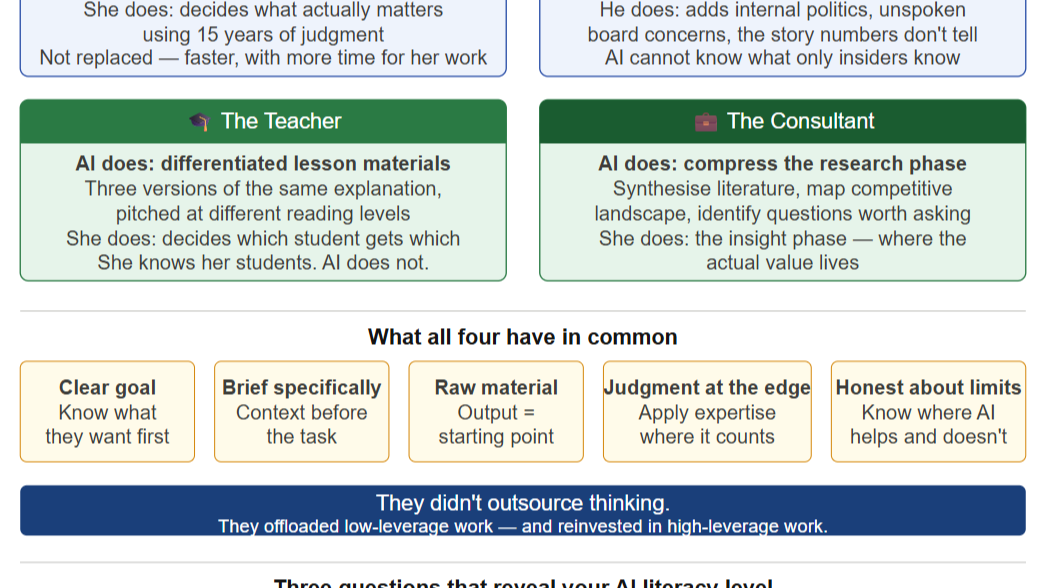
It looks like a lawyer who uses AI to do the first pass on contract review — pulling out non-standard clauses, flagging deviations from template — and then applies her fifteen years of judgment to decide what actually matters. She is not replaced. She is faster. And she has more time for the work that requires her specifically.
It looks like a finance director who uses AI to draft his board commentary — first cut, right structure, right tone — and then edits for the three things AI cannot know: the internal politics, the unspoken concerns of specific board members, the story the numbers are not yet telling.
It looks like a teacher who uses AI to generate differentiated lesson materials — three versions of the same explanation, pitched at different reading levels — and then decides which student gets which version, because she knows her students and the AI does not.
It looks like a consultant who uses AI to compress the research phase — synthesising literature, mapping the competitive landscape, identifying the questions worth asking — so she can spend more of her time on the insight phase, which is where the actual value lives.
What these people have in common:
They know what they are trying to achieve before they open the tool. They brief specifically. They treat the output as raw material, not finished product. They apply their own judgment at the point where judgment actually matters. And they are honest about where AI helps and where it does not.
None of them outsourced their thinking. They offloaded the parts that did not require their specific expertise — and reinvested that time in the parts that did.
Three questions that reveal your AI literacy level:
One — Can you articulate, in one sentence, what this AI output is missing that only you can add? If you cannot answer that, you may be over-relying.
Two — Do you know which parts of your work AI is genuinely bad at? If you cannot name them, you may be under-using — or about to make a costly mistake.
Three — Has your use of AI changed how you spend your time — or just how fast you produce the same output? The real value of AI is not speed. It is reallocation. Moving your time from low-leverage to high-leverage work.
AI literacy is not knowing how the model works.
It is knowing how you work — and using AI to do more of what only you can do.