
Safety culture communication is the one thing every checklist, alarm, and procedure on a ship still can’t replace.
Shipping is full of rules. Checklists. Procedures. Alarms. Posters with motivational quotes about “Safety First.”
And don’t get me wrong — rules exist for a reason. They save lives, protect the environment, and keep insurers from sending very angry letters written in very precise legal language.
But here’s the inconvenient truth:
Ships don’t run on rules. They run on humans. And humans… like to talk.
Or at least — they should.
Because somewhere between the checklist and the coffee break, something strange has happened in our industry:
We’ve become very good at documenting safety… and not nearly as good at discussing it. That gap is exactly where safety culture communication either lives or dies.
The Conversation Gap
Onboard, in offices, during cargo ops, over handheld radios, and through that “urgent” phone call from the terminal — shipping is a constant stream of information.
But not all information flows equally.
We’ve built systems that reward compliance, not curiosity. Tick the box, complete the form, close the loop.
But what about the things that don’t fit neatly into a box?
A deckhand notices a faint but unusual smell near the fuel hose. Not strong enough to trigger an alarm. Not obvious enough to justify stopping operations. Just… off.
Does he raise it? Or does he assume someone else has already noticed?
A junior officer sees a step in the procedure quietly skipped to save time. It’s minor. It’s common. It’s “how things are done.”
Does she question it? Or file it mentally under “probably fine”?
A superintendent visiting the vessel spots a workaround in action — clever, efficient, and completely undocumented.
Does he challenge it? Or admire the ingenuity and move on?
The result of these tiny, daily decisions:
- Near-misses that never get reported
- Weak signals that never get amplified
- Small risks that quietly mature into big ones
And then one day, something happens.
An incident. A spill. A near collision. A system failure that “came out of nowhere.”
Except it didn’t.
Spoiler alert: a five-minute conversation could have prevented it all.
But who has five minutes when the KPIs are glowing green and the schedule is already tight?
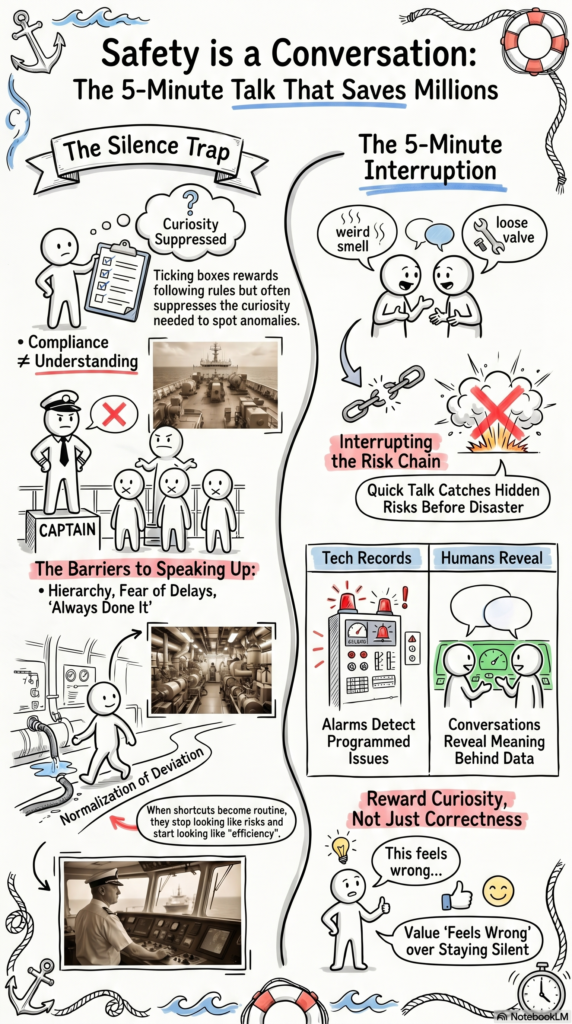
Why People Don’t Speak Up
It’s easy to say “encourage communication.”
It’s much harder to understand why communication doesn’t happen.
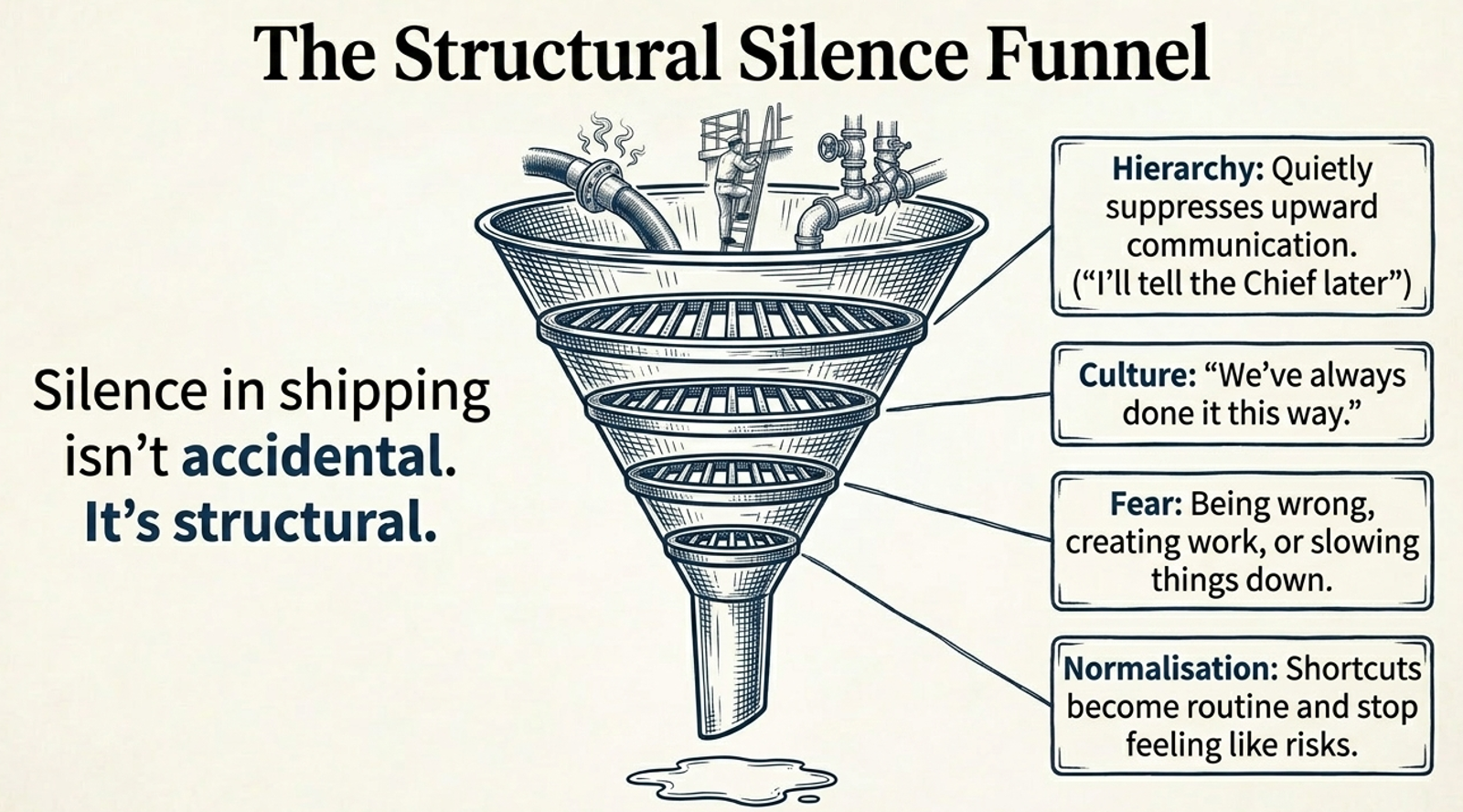
Because silence in shipping isn’t accidental. It’s structural— and it’s the same structural blindspot we unpacked in The Human Factor #10 – Auditing Steel Instead of Souls, where hierarchy quietly rewards silence over honesty.
Hierarchy:
Shipping still runs on clear chains of command — and for good reason. But hierarchy can quietly suppress upward communication.
“I’ll tell the Chief.” “Maybe later.” “Actually… it’s probably nothing.”
Culture:
“We’ve always done it this way.” Which is one of the most efficient ways to shut down a conversation without technically saying “stop talking.”
Fear:
Not dramatic fear — no one’s expecting a courtroom scene. Just the everyday kind:
- Fear of being wrong
- Fear of creating extra work
- Fear of being the person who “slows things down”
- Fear of paperwork multiplying like it has a life of its own
Normalisation of deviation:
When small shortcuts become routine, they stop feeling like risks. They become “the way things work.” And once something feels normal, it rarely gets questioned.
The irony? Most people onboard do notice when something isn’t right. They just don’t always say it out loud.
Conversations That Actually Save
Now for the part that doesn’t get enough attention — because it doesn’t make headlines. This is safety culture communication working exactly as it should, quietly, the way we described it in The Human Factor #9 – The Unicorn of Shipping.
The incidents that don’t happen.
The hose that gets checked twice because someone said, “Hang on, that doesn’t look right.”
The transfer that gets paused because someone asked, “Are we sure about this valve?”
The near-miss that gets discussed openly instead of quietly buried.
Some companies are starting to understand this. Not through slogans — but through behaviour. They create environments where:
- Real-time reporting is normal, not exceptional
- People can say “this feels wrong” without needing a full technical justification
- Short, informal check-ins are encouraged during high-risk operations
- Minor issues are treated as learning moments — not administrative burdens
And something interesting happens when you do this.
The volume of “small conversations” increases. And the number of “big surprises” decreases.
Because risk doesn’t usually appear fully formed. It builds quietly — until someone interrupts it.
💡 A five-minute conversation is often just a risk interrupted early.
Digital Tools Aren’t Enough
Modern ships are packed with technology. Alarms. Sensors. Dashboards. Predictive systems. Data streams that would have looked like science fiction 20 years ago. The IMO’s work on the human element makes the same point: no amount of automation substitutes for real safety culture communication between crew.
And they are valuable — no question. But they all share one limitation:
They only detect what they are designed to detect.
They don’t question assumptions. They don’t challenge procedures. They don’t say, “This doesn’t feel right.”
Your dashboard might be glowing green across the board. Meanwhile, on deck, the crew has just improvised a workaround to prevent a minor issue from escalating.
It worked. Crisis avoided. No alarms triggered.
And unless someone talks about it — that knowledge disappears. No report. No lesson learned. No system improvement. Just a quiet success that never gets counted.
💡 Technology records events. Conversations reveal meaning.
The Simple Lesson
Shipping doesn’t need fewer rules. And it probably doesn’t need dramatically more either.
What it needs is something far less complicated — and far more human: better dialogue.
- Stop equating silence with safety
- Recognise that compliance does not equal understanding
- Reward curiosity, not just correctness
- Make it normal to pause and ask, “Are we sure?”
Because here’s the reality:
Most catastrophic incidents are not caused by a single failure. They are the result of multiple small signals — missed, ignored, or unspoken.
And often, all it takes to break that chain… is one person saying something.
One question. One observation. One slightly uncomfortable conversation that lasts five minutes.
That’s it.
Five minutes that might delay an operation slightly — or prevent a million-dollar claim, a regulatory investigation, or something far worse.
Because at the end of the day:
No checklist can replace awareness. No procedure can replace judgment. And no system can replace humans actually talking to each other.
Safety isn’t a checklist. Safety is a conversation. And that conversation is what safety culture communication actually means in practice.
📌 When did a quick conversation save you from a disaster?
Share the story. (We need more examples of what good looks like.)
Fiction from the same sea: The Measurable Horizon, Book 5: Accountability in the Age of Visibility →
Related reading: Be the CEO of Your Life: Leading Yourself Before Leading the Ship · The Cultural Disease