
Welcome to the First Annual (Probably Recurring) Boys-Men Mental Safety Month, brought to you by the same sarcastic mariners responsible for Sea, Salt & Reflections.
Some men don’t burn out dramatically.
No explosion.
No breakdown.
No movie scene in the rain.
They just slowly become unavailable to themselves.
Functioning.
Providing.
Replying to emails.
Making jokes.
Paying bills.
Attending birthdays.
Existing like machinery that’s overdue for maintenance but still technically operational.
That’s the dangerous part.
Because the world rewards functional suffering.
A tired man who keeps producing?
Useful.
A stressed father who keeps showing up?
Reliable.
A burned-out employee who still answers emails at 11:48 PM?
Leadership material.
And after enough years, many men stop asking:
“How do I feel?”
They only ask:
“Can I still perform?”
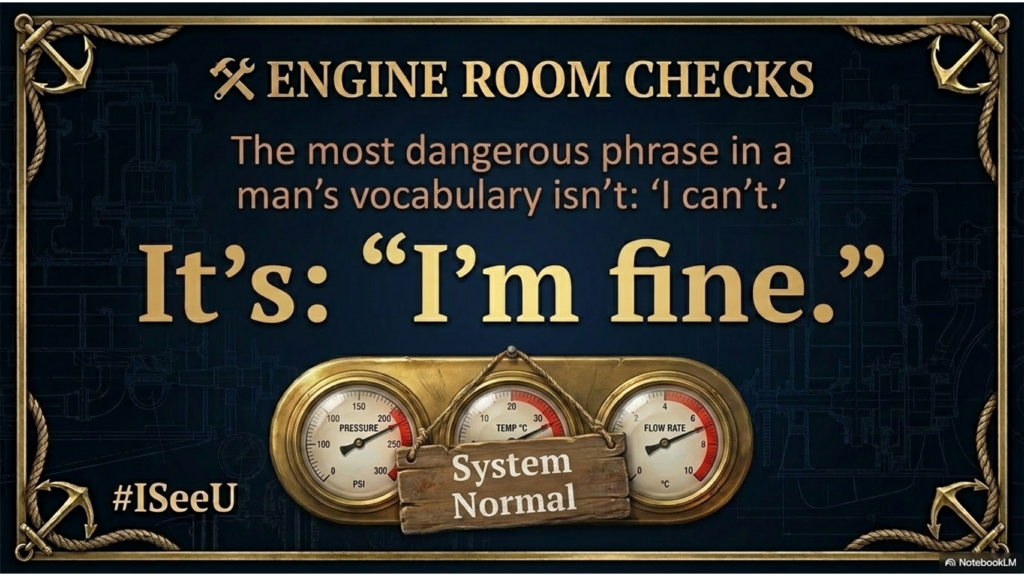
This is why men say I’m fine instead of the truth
“I’m fine” becomes less of a sentence and more of a survival mechanism.
Not because they’re lying intentionally.
Because they genuinely lose access to the language underneath it.
The engine never shuts down long enough for inspection.
And eventually:
The body keeps score.
The temper shortens.
The silence deepens.
The joy leaks quietly out of ordinary things.
The frightening truth is this:
Most struggling men do not look visibly broken.
They look dependable.
Which is why so many collapse in complete silence while everyone around them says:
“But he seemed fine.”
Of course he did.
He spent years rehearsing it. It’s exactly why men say I’m fine on autopilot — the line comes out before the truth even has a chance to form.
Maybe strength was never supposed to mean:
“carry everything alone without complaint.”
Maybe strength is recognising when the engine needs maintenance before the ship starts taking water.
Maybe “I’m tired” deserves the same respect as “I’m injured.”
Maybe the strongest thing a man can say is:
“This is getting heavy.”
Not dramatic.
Not weak.
Just human.
#ISeeU
The novel behind this series: I See U →