
Ever notice how many vessels seem designed for officers who don’t exist?
They never get tired, never lose focus, and somehow manage to read a display panel positioned at ankle height while steering through a typhoon.
Unfortunately, those officers only exist in PowerPoint presentations—not on the bridge at 0300 hours after a 12-hour watch cycle, halfway through their second coffee and questioning their life choices.
Welcome to the not-so-small problem of fatigue, design misalignment, and human factors design in shipping at its most neglected.
The illusion of “rest hours”
The industry loves paperwork solutions. When fatigue comes up, the default answer is:
“Well, rest hours are regulated, aren’t they?”
Yes, they are. Logged, signed, filed, and occasionally… interpreted creatively.
But let’s be honest—ticking a rest-hour box doesn’t magically refresh the brain of a third officer who’s just been jolted awake by a cascade of alarms, a phone call from the bridge, and a vibration that suggests something, somewhere, is not behaving as designed.
Fatigue isn’t just about duration of sleep. It’s about quality, timing, and interruption.
- Where you sleep (next to a humming engine room or slamming hatch covers)
- How often you’re interrupted (spoiler: more than anyone admits)
- What you’re expected to do while tired (complex navigation, cargo ops, paperwork marathons)
And then there’s the hidden layer: cognitive fatigue.
Switching between systems. Re-entering the same data across multiple platforms. Interpreting alarms that all look equally urgent. Managing communications from shore while maintaining situational awareness at sea.
In other words: fatigue isn’t an operational side effect.
It’s often engineered into the workflow—and sometimes into the ship itself.
Design misalignment in action
These are the monuments to what happens when human factors design in shipping gets treated as someone else’s problem.
- The chiropractor’s bridge:
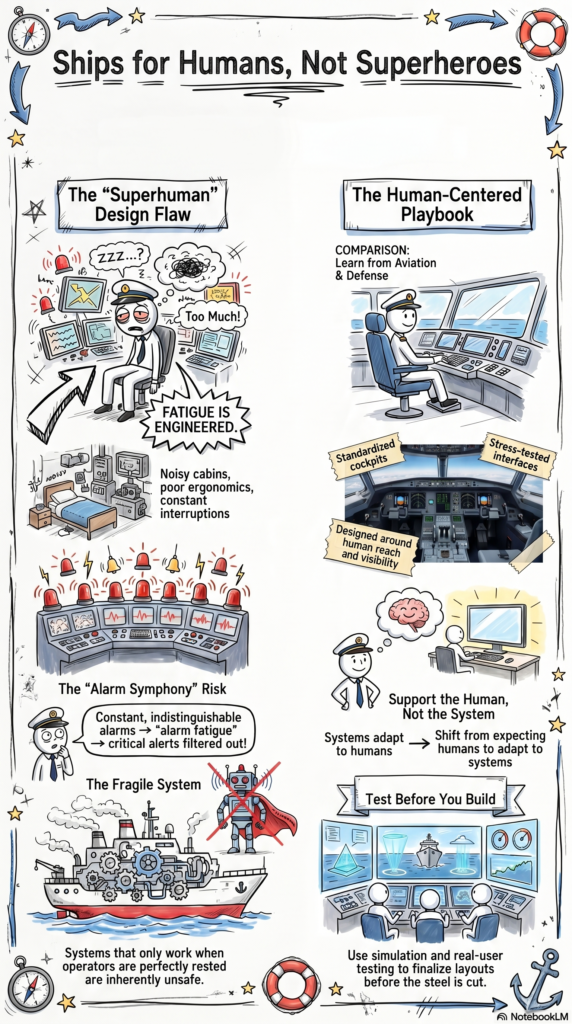
Radar, ECDIS, and conning displays arranged as if ergonomics were an optional upgrade package. Perfect—if you happen to be 6′4″, left-eye dominant, and capable of rotating your spine like an owl. Everyone else? Welcome to chronic discomfort and reduced attention span. - The alarm symphony:
Every system believes it is the most important system. So everything alarms. Frequently. Loudly. Indistinguishably.
The result? Alarm fatigue. The human brain starts filtering noise—until the one alarm that matters gets filtered too. - The shoebox cabin:
Cabins located conveniently close to sources of noise, vibration, and intermittent impact sounds. Because apparently, restorative sleep is best achieved in an environment resembling light industrial activity. - The anti-sunlight display:
Screens that perform beautifully—until exposed to daylight. At which point they transform into reflective mirrors, forcing officers to squint, shade, and guess their way through critical information. - The “just one more system” problem:
Individually, each system makes sense. Collectively, they create a fragmented interface where humans become the integration layer—manually stitching together information across platforms that were never designed to talk to each other.
These aren’t minor inconveniences. They are risk multipliers—small frictions that accumulate until they shape decisions, delay reactions, and erode situational awareness.
The consequences we pretend not to see
Pick almost any major incident—groundings, collisions, near misses—and fatigue is somewhere in the background. Not always the headline cause, but almost always a contributing factor.
Reduced alertness. Slower reaction times. Missed cues. Poor judgment under pressure.
And yet, in many investigations, fatigue is acknowledged… then quietly sidelined.
Why?
Because it’s easier to point to a failed component than a flawed design philosophy.
Easier to retrain a crew than to redesign a bridge.
Easier to write a new checklist than to admit the system itself needs rethinking.
But here’s the uncomfortable truth:
If your operation only works when the human operator is well-rested, fully alert, and never overloaded—you haven’t built a safe system.
You’ve built a fragile one.
This is where human factors design in shipping gets quietly sidelined in favor of retraining
Human Factors Design in Shipping: The Elephant Nobody Wants to Name
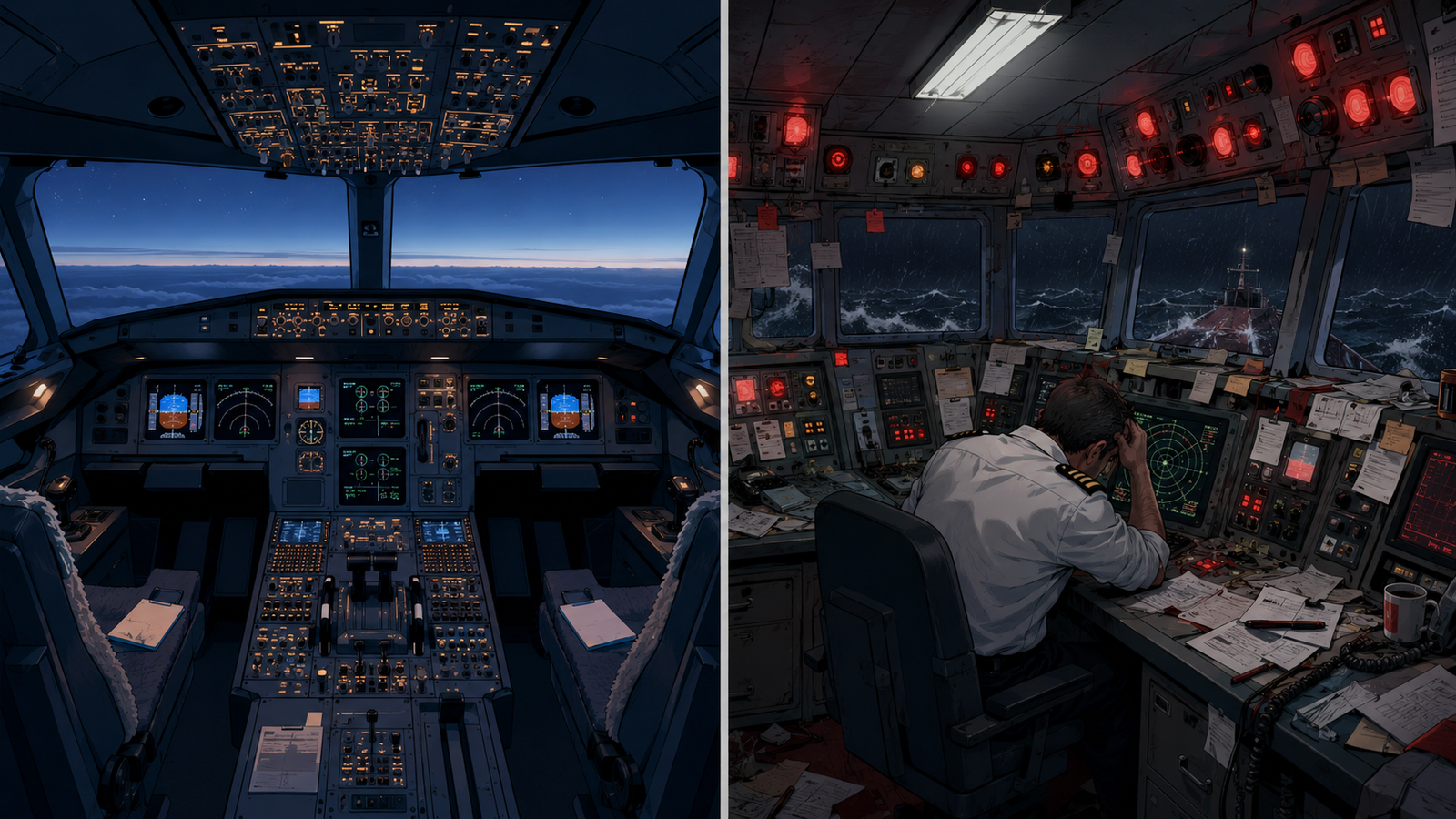
Aviation learned this lesson the hard way—then did something about it.
Cockpits are designed around reach, visibility, and cognitive load. Controls are standardised. Alerts are prioritised and differentiated. Workflows are tested in simulators before they ever reach a live aircraft.
Why? Because aviation accepted a fundamental reality early on:
Humans are not perfect. So systems must be designed accordingly.
And here’s where it gets even more interesting—defense has been doing this for years.
Warships, submarines, and control rooms are built with human limitations in mind:
- Clear lines of sight
- Logical control grouping
- Redundancy without overload
- Interfaces tested under stress conditions
Because in those environments, performance degradation isn’t theoretical—it’s expected. And designed for.
Meanwhile, parts of commercial shipping still treat human factors as a retrofit. Something to consider after the steel is cut, the layout is fixed, and the budget is… less flexible.
The result? Ships designed for superhumans, operated by very human crews.
A sarcastic reality check
The industry says “safety first.” And to be fair, there are genuine efforts being made.
But in practice, safety often still looks like:
- Adding another checklist
- Accepting alarm overload as “normal”
- Relying on procedures to compensate for poor design
- Issuing guidance instead of changing hardware
Because clearly, the solution to cognitive overload is… more documentation.
And nothing says “fatigue management” like a cabin where the bulkhead doubles as a subwoofer every time the engine changes load.
So, what’s the fix?
It’s not revolutionary. It’s just… overdue.
- Design bridges, cabins, and systems around real human capabilities—not idealised ones
- Reduce unnecessary complexity instead of training people to live with it
- Integrate systems so humans interpret information, not assemble it
- Use simulation and real-user testing before finalising layouts
- Accept that fatigue will happen—and design systems that remain safe when it does
This is what taking human factors design in shipping seriously actually looks like — not a workshop slide, not a circular, not another checklist.
A shift in thinking—from expecting humans to adapt to systems, to designing systems that support humans.
The sneaky nudge
Some parts of the industry are already moving. Slowly, quietly, but noticeably.
Human factors engineering is no longer just academic theory—it’s embedded in high-risk sectors where failure is not an option. Defense projects have shown what’s possible when design starts with the operator, not the equipment.
Commercial shipping doesn’t need to reinvent the wheel. It just needs to stop ignoring a playbook that already works.
Because if we continue designing ships for superheroes, we shouldn’t be surprised when very human crews struggle to meet impossible expectations.
And when they do, it won’t be because they weren’t good enough.
It’ll be because the system never gave them a fair chance.
Because human factors design in shipping isn’t optional — it’s the difference between a fragile system and a safe one.
📌 What’s the worst design feature you’ve encountered on a ship?
Let’s start a list. (Anonymously, if needed.)