
Dr. Kumud R. Jha · Singapore · Doctorate in AI · US Patent Holder View LinkedIn Profile
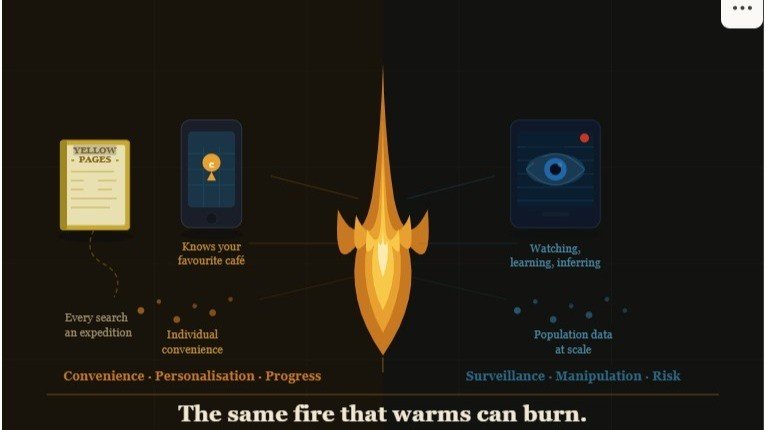
Do you remember the Yellow Pages?
A thick, unwieldy book delivered to your doorstep once a year. Finding a plumber meant flipping through hundreds of pages, calling three wrong numbers, and hoping for the best. Every search was a minor expedition. Every recommendation came from a friend, a notice board, or sheer luck.
Today, your phone knows your favorite café. It knows when you wake up, which route you take to work, and — with reasonable accuracy — when you are likely to fall asleep. It does not need to be told. It simply watches, learns, and infers. This is the same shift Dr. Jha framed when he asked whether AI is something to fear or something to understand — and privacy is where that question gets most personal.
This is the trade we made — AI surveillance for convenience. And most of us made it willingly, because the convenience was extraordinary.c
Here is the thing about your data that almost nobody explains clearly:
Your individual data — where you went on a Tuesday, what you searched for at 11pm — has relatively little value on its own. But aggregated across millions of people over years, that data becomes something remarkable. It can predict disease outbreaks before hospitals notice them. It can route ambulances more efficiently than any dispatcher. It can personalize education to a child’s learning pace. It can help a first-generation university student find scholarships their school never told them about.
Individual data points are scattered puzzle pieces. Collected at population scale, they become a map of human behavior that can genuinely improve lives.
But this does not make it safe. And it does not make it neutral.
Think of fire. Fire heated homes for ten thousand years before central heating existed. Fire cooked food, forged steel, powered the industrial revolution. Fire also burned cities, was used as a weapon of war, and continues to be weaponized today. The same force. Radically different outcomes. Entirely dependent on who controls it and under what rules.
AI and personal data work exactly the same way.
The smartphone that knows your morning routine can help a health app detect early signs of burnout. The same data, in the wrong hands or under weak regulation, can be used to manipulate your decisions, deny you insurance, or track your political activity without your knowledge.
Most people assume AI surveillance is something governments do to us. The truth is more layered. AI-powered privacy tools now exist to detect when apps are over-collecting your data, flag unusual account access, and encrypt your communications automatically. The same technology that can track you can also protect you.
It is not the AI that decides which purpose to serve. It is the laws, the policies, and the companies we choose to hold accountable.
This does not mean dropping your guard. It means directing your concern precisely — demanding transparency from platforms and regulators, exercising the data rights you already have, and treating your personal data with the same thoughtfulness you would apply to any valuable asset.
Fire did not stop being useful because it could also burn. We built codes, regulations, smoke alarms, and fire brigades. We learned to manage it.
That is exactly what humanity needs to do with AI and personal data. And that work — messy, imperfect, urgent — is already underway.
What is one privacy setting on your phone you have never checked? Today might be a good day to look