
Dr. Kumud R. Jha · Singapore · Doctorate in AI · US Patent Holder View LinkedIn Profile
Before we talk about AI misinformation, let me take you back to 1938.
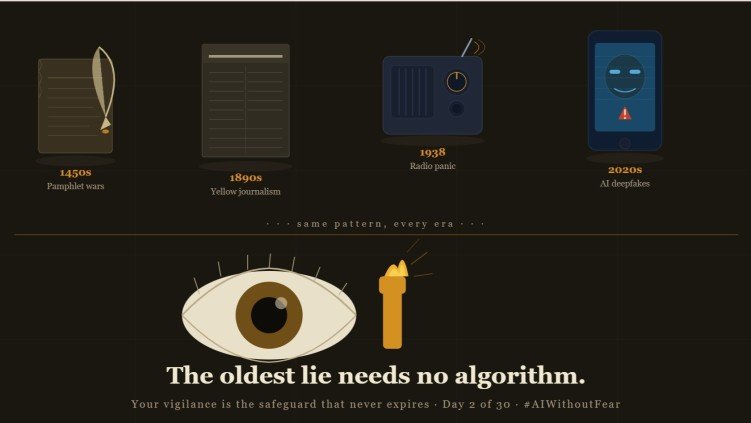
On the night of 30 October, millions of Americans tuned into their radios and heard a breaking news report: Martians had landed in New Jersey. Panic spread. People fled their homes. Some reportedly suffered heart attacks. The broadcast was Orson Welles reading The War of the Worlds — a work of fiction, performed as a news bulletin, with zero AI involved.
No algorithm. No deepfake. No synthetic voice. Just a microphone, a script, and human credulity.
Misinformation is not an AI invention. It is a human condition.
Go further back. In 1898, American newspapers — led by William Randolph Hearst — published fabricated atrocity stories to inflame public opinion against Spain. The resulting hysteria helped drag the United States into the Spanish-American War. Historians still debate how many people died because of what was essentially coordinated fake news, printed on paper, delivered by horse and cart.
In World War I, British propagandists published fabricated stories of German soldiers bayoneting Belgian babies. The stories were false. They shaped global opinion and recruitment for years.
The pattern is always the same: a powerful communication technology arrives, bad actors weaponise it faster than society can adapt, and then — slowly, imperfectly, but meaningfully — the safeguards catch up.
The printing press gave us the Reformation and the pamphlet wars. Radio gave us Welles and Goebbels. Television gave us doctored footage and manufactured consent. The internet gave us viral hoaxes and coordinated disinformation at scale.
And now AI is accelerating the same old game.
But here is what the doomsday headlines consistently miss: the safeguards are catching up again. They always do.
The Content Credentials standard — backed by Adobe, Google, Meta, Microsoft, and dozens of news organisations — now embeds invisible watermarks into AI-generated content. Platforms are deploying AI detection models that flag synthetic media before it trends. The EU AI Act mandates disclosure labels on AI-generated content. Dozens of universities now offer media literacy as a core graduate skill.
None of this is perfect. None of it ever is. The lie always travels faster than the correction — that was true in 1898 and it is true today.
But your most powerful safeguard has never changed: a deliberate pause before you share.
Ask three questions before you amplify anything that makes you feel outraged, frightened, or vindicated:
- Can I find this reported by a second, independent source?
- Does the person or outlet sharing this have something to gain from my reaction?
- Am I sharing this because it is true — or because it confirms what I already believe?
Those three questions, applied habitually, make you more resistant to manipulation than any technology ever built. That was true in 1938. It is true today.
The threat is real. So is your ability to meet it.