
Dr. Kumud R. Jha · Singapore · Doctorate in AI · US Patent Holder View LinkedIn Profile
Five days ago I made the historical case — every wave of automation destroyed jobs that existed and created jobs nobody had imagined. The pattern held. Workers adapted. Societies (eventually) adjusted.
Today I want to be honest with you about why that argument, while true, is incomplete.
AI is different in one critical way: it is the first general-purpose technology that competes with cognitive labour at scale.
The loom replaced weavers. The tractor replaced farm hands. The ATM replaced cash-counting. Each displaced a specific physical skill.
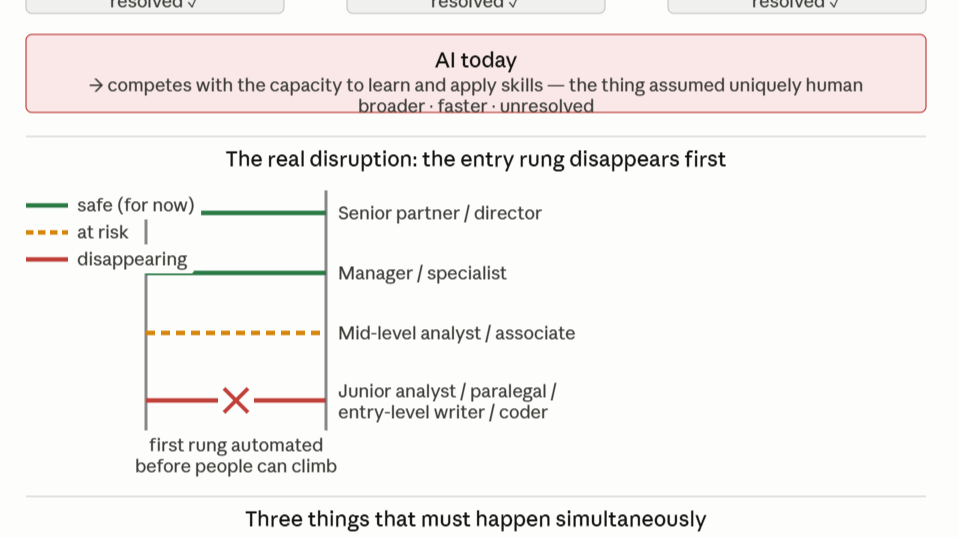
AI doesn’t replace a skill. It competes with the capacity to learn and apply skills — the thing we always assumed was uniquely and safely human.
That changes the speed. That changes the breadth. That changes who is vulnerable.
Here is what the data actually shows: the collision between AI and entry-level jobs isn’t happening where you’d expect.
Roles most at risk are not the ones you might expect. It is not factory workers — it is paralegals, junior analysts, customer service agents, medical coders, and entry-level writers. The first rung of the professional ladder is being automated before the people on it have had a chance to climb.
That is the real disruption. Not mass unemployment in the short term — but a broken ladder. The junior roles that used to train the senior professionals of tomorrow are disappearing first.
So what is the honest answer?
Three things need to happen simultaneously — and none of them are the responsibility of individuals alone:
First, education systems need to shift from credentialing knowledge to building adaptability. Not “what do you know” but “how quickly can you learn what you don’t know yet.”
Second, social contracts need to evolve. The link between employment and security — healthcare, pensions, housing — was designed for a world of stable long-term jobs. That world is already changing.
Third, the transition cost must be shared. When a technology creates value at the top and displacement at the bottom, the people who capture the value should help fund the people navigating the transition.
None of this is radical. All of it is hard.
The question is not whether AI will change work. It already is.
The question is whether we design the transition — or just survive it.