
Dr. Kumud R. Jha · Singapore · Doctorate in AI · US Patent Holder View LinkedIn Profile
Seven days ago I showed you the data trail you leave behind every day — every search, every click, every pause on a video.Every location ping. Feeding systems that know your habits better than your closest friends do.
Today I want to address the feeling that follows that realisation.
Helplessness.
Because most people, when they truly understand the scale of data collection, land in one of two places: denial (“I have nothing to hide”) or fatalism (“there’s nothing I can do”).
Both are wrong. And both serve the people who benefit from your passivity.
Here is what is actually being built to give you back control.
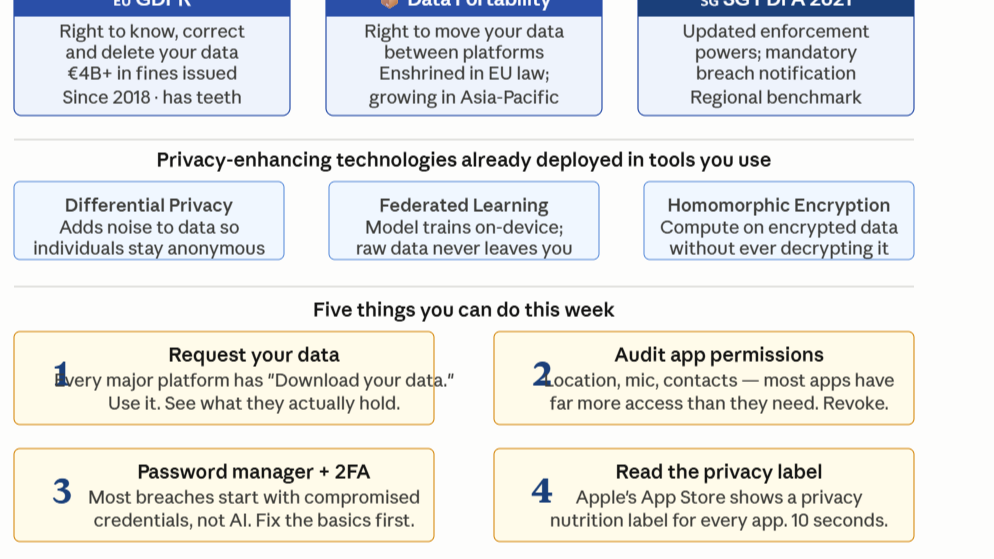
The EU’s General Data Protection Regulation — GDPR — established something radical in 2018: the legal right to know what data is held about you, to correct it, and in many cases to delete it entirely. It has issued over €4 billion in fines since. It has teeth.
Data portability — the right to take your data from one platform and move it to another — is now enshrined in law across Europe and gaining ground in Asia. Singapore’s Personal Data Protection Act was updated in 2021 with significant new enforcement powers.
Privacy-enhancing technologies — differential privacy, federated learning, homomorphic encryption — sound like academic jargon. They are not. They are already deployed inside the tools you use. Apple’s on-device AI processing, Google’s federated learning for keyboard predictions — your data never leaves your device. The industry is being pushed, slowly and unevenly, toward privacy by design.
And then there is the most underused tool of all: your own choices.
Five things you can do this week:
One — Request your data. Every major platform has a “Download your data” option. Use it. See what they actually hold.
Two — Audit your app permissions. Location, microphone, contacts — most apps have far more access than they need. Review and revoke.
Three — Use a password manager and enable two-factor authentication. Most privacy breaches start with compromised credentials, not AI.
Four — Read the privacy label. Apple’s App Store now shows a privacy nutrition label for every app. It takes ten seconds.
Five — Opt out where you can. Ad personalisation, data sharing with third parties, cross-site tracking. Most platforms bury the opt-out. It exists.
None of this makes you invisible. That is not the goal.
The goal is to move from passive subject to informed participant. To shrink the gap between what you know is happening and what you can do about it.
Privacy is not about hiding. It is about choosing.