
Dr. Kumud R. Jha · Singapore · Doctorate in AI · US Patent Holder View LinkedIn Profile
AI and Creativity: Why Pattern Isn’t the Same as Experience
Eight days ago I showed you AI as a remix engine — trained on millions of human creative works, recombining patterns. Producing outputs that look, sound, and read like something a human made.
Today I want to sit with the question that keeps creative professionals up at night: what does AI and creativity actually mean for authorship, now that AI can write, paint, compose, and code?
If AI can write, paint, compose, and code — what is left for us?
Let me tell you what AI cannot do. Not yet. Possibly not ever.
AI cannot have a bad year that changes everything it makes next year. It cannot lose someone and let that loss reshape its entire creative voice. It cannot be furious at an injustice and need to make something because the alternative is silence.
AI creates from pattern. Humans create from experience. That is not a small difference.
The greatest creative works — the ones that endure — are not impressive because they are technically flawless. They endure because they are true. Because a specific human, in a specific moment, found a form for something real.
AI has no specific moment. It has no stakes.
But here is where it gets complicated.
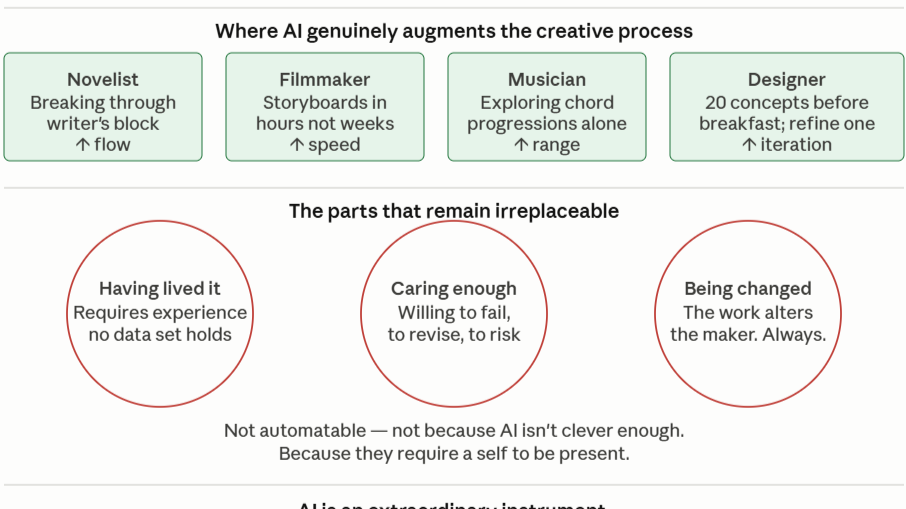
The tools are genuinely extraordinary. A novelist using AI to break through writer’s block. A filmmaker generating storyboards in hours instead of weeks. A musician exploring chord progressions they would never have reached alone. A graphic designer producing twenty concepts before breakfast, then spending the day refining the one that feels right.
This is not AI replacing creativity. This is AI changing what the creative process looks like.
The question is not “will AI make artists obsolete?” The better question is: “which parts of the creative process are uniquely human, and how do we protect and invest in those?”
The answer, I think, is this: the parts that require you to have lived. The parts that require you to care. The parts that require you to be willing to be wrong, to fail publicly, to revise, to be changed by the work itself.
Those parts are not automatable. Not because the technology isn’t clever enough. But because they require a self — a specific, mortal, vulnerable self — to be present.
AI is an extraordinary instrument. The question is who plays it, and what they are trying to say.