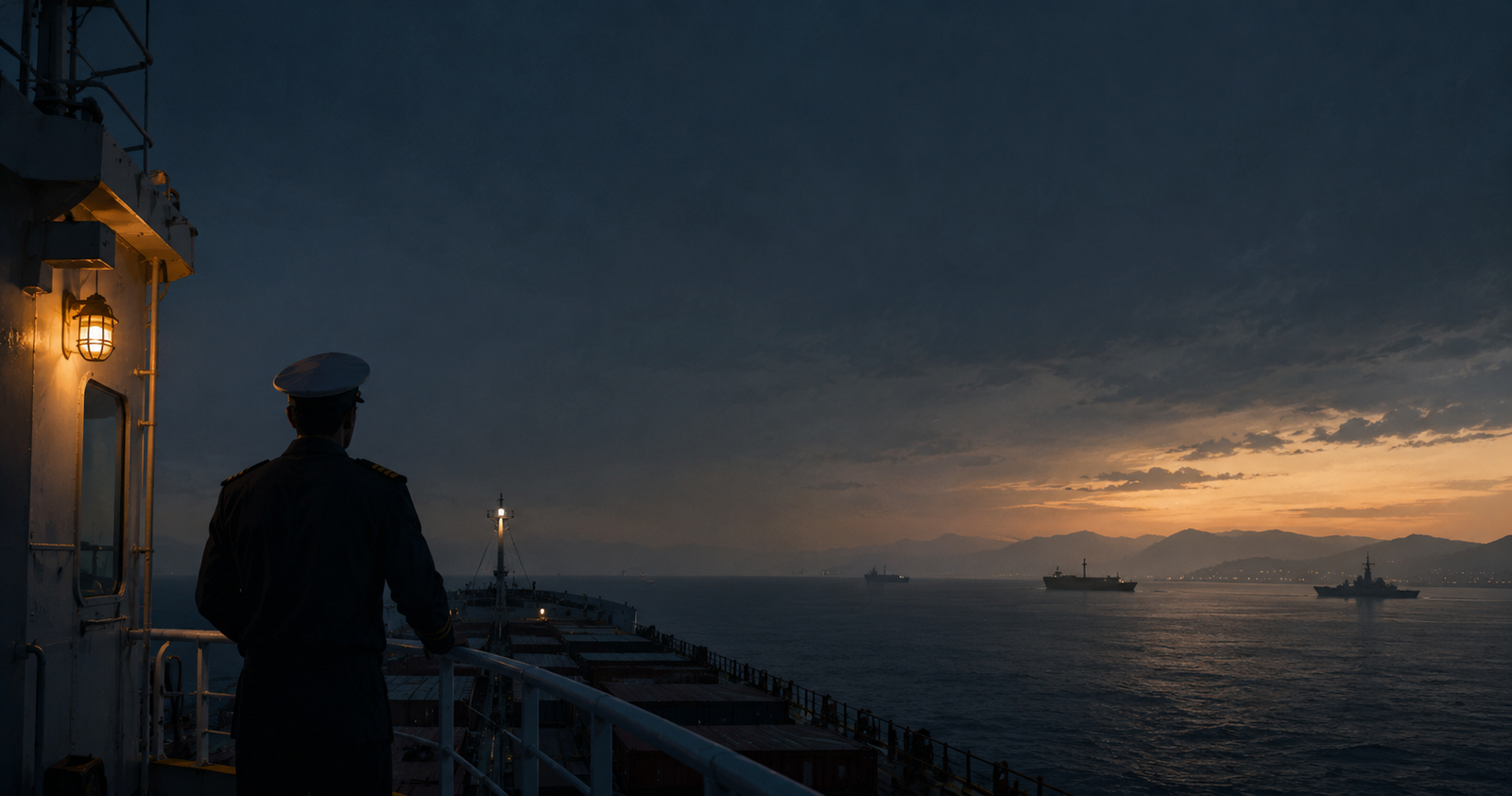

A ceasefire may be signed. For thousands of seafarers, the human cost is not over.
Disclaimer
The Sarcastic Mariner(s) are not diplomats, intelligence analysts, or geopolitical experts.
We’re maritime people.
We look at ships, crews, casualties, and consequences.
And sometimes the most important question is not who started the fight.
It’s who is still stuck in the middle of it.
The Headlines Say “Ceasefire”
The reality says something else.
Governments announce agreements.
Markets react.
Oil prices move.
Analysts debate winners and losers.
Meanwhile, somewhere in the Gulf region, a Chief Officer is still checking mooring lines on a vessel that should have left weeks ago.
A Chief Engineer is still nursing machinery through another delay.
A crew member is still explaining to his family why he isn’t home yet.
Again.
Because while ceasefires can be signed overnight, normality rarely returns that quickly.
Shipping knows this better than most.
The Human Cost Never Fits in a Headline
Whenever tensions escalate around strategic waterways, the conversation quickly turns to economics.
Oil.
Trade.
Insurance.
Supply chains.
Very little attention is paid to the people actually operating the ships.
Yet every attack, detention, delay, diversion, or security incident eventually lands on the shoulders of a seafarer.
Some have paid with their lives.
Others with injuries.
Thousands more with uncertainty, fatigue, extended contracts, disrupted reliefs, and months of stress that will never appear in an incident database.
The casualty figures matter.
But so do the people who survived and must continue sailing through the aftermath.
The Strait May Reopen. The Problem Doesn’t Disappear.
History shows that reopening a waterway is the easy part.
Restoring confidence is harder.
Operators need certainty.
Masters need reliable guidance.
Crews need assurance that the route they are being asked to sail is genuinely safe.
And insurers need something they rarely receive during geopolitical crises:
Predictability.
Until that confidence returns, every transit becomes a risk calculation.
Every voyage plan becomes a discussion.
Every delay becomes another phone call home.
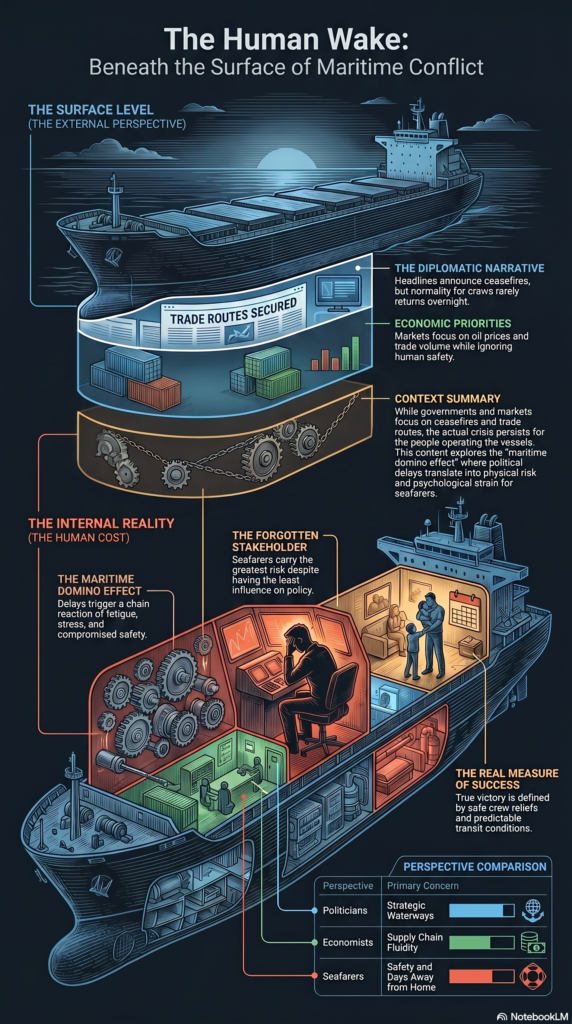
The Maritime Domino Effect
The public often sees one incident.
Shipping sees fifty consequences.
A delayed vessel affects schedules.
Schedules affect crew changes.
Crew changes affect fatigue.
Fatigue affects decision-making.
Decision-making affects safety.
One disruption quickly becomes an operational chain reaction stretching across fleets and continents.
This is the part that rarely makes the evening news.
The vessel eventually sails.
The headline disappears.
The accumulated human and operational pressure remains.
The Human Cost Never Fits in a Headline
During every geopolitical crisis, there is one group that consistently finds itself caught between competing interests.
Not governments.
Not energy companies.
Not financial markets.
Seafarers.
The people with the least influence over the situation often carry the greatest immediate risk.
They do not decide foreign policy.
They do not negotiate ceasefires.
They do not impose sanctions.
Yet they are expected to continue operating ships through the consequences of all three.
The Real Measure of Success
The success of any ceasefire, agreement, or diplomatic breakthrough should not be measured solely by political statements.
It should be measured by outcomes.
Can vessels transit safely?
Can crews be relieved on time?
Can families stop worrying?
Can shipowners and Masters make operational decisions without extraordinary risk?
If the answer remains uncertain, the crisis may be quieter.
But it is not necessarily over.
The TSM Take
Shipping has a remarkable ability to keep moving through chaos.
Wars.
Pandemics.
Financial crises.
Political disputes.
The industry adapts because it has to.
But resilience should never be mistaken for invulnerability.
The people who keep global trade moving are not statistics on a dashboard.
They are fathers, mothers, sons, daughters, husbands, wives, friends, and colleagues.
And long after politicians move on to the next crisis, they are often the ones still dealing with the consequences.
Final Thought
Politicians see a strategic waterway.
Economists see a supply chain.
Insurers see a risk model.
Shipowners see an operational challenge.
Seafarers see another day away from home.
And perhaps that’s the perspective we should spend more time talking about.
Because regardless of where you stand politically, one fact remains remarkably consistent:
The cargo eventually arrives.
The invoice eventually gets paid.
The people are the part we cannot replace.
The Situation Room. #0 – What we talk about
The Situation Room. #1 – 3,200 Ships, One Doorway: What Happens When the Strait Becomes a Wall
The Situation Room. #2- The Strait Closed. The Questions Opened.
The Situation Room. #3 – “Hormuz: The Questions Every Ship Is Asking (But Few Are Saying Out Loud)”
The Situation Room. #4 – One Month Adrift
The Situation Room. #5 – Strait of Chaos: The Ceasefire That Wasn’t
The Situation Room. #6 – The 2026 COLREGS
The Situation Room. #7 – India’s Sovereign Play Against the P&I System
The Situation Room. #8 – The EU AI Act SHIPPING
The Situation Room. #9 – THE FUTURE OF Alternative Fuels in Shipping
The Situation Room. #10 – The Ship of Fools
The Situation Room. #11 –The Grumpy Mariner’s Guide to 2026’s Maritime Rulebook