

4 min read
In this article
Battery Container Is Still a Container… Until It Isn’t.
“Singapore tightens the handling of battery-related dangerous goods. The interesting part isn’t the surcharge.”
The Disclaimer
For discussion and awareness only. Not legal, regulatory, or operational advice. Always verify applicable requirements with the relevant authorities, carriers and terminal.
Battery cargo has been keeping the maritime industry busy for a while.
- Fire investigations.
- New UN numbers.
- New IMDG requirements.
- New terminal controls.
- New carrier charges.
And, increasingly, a very simple question:
“What happens to that battery container after it has been declared and dropped into the supply chain?”
Because that’s where things are getting interesting.
What has changed in Singapore?
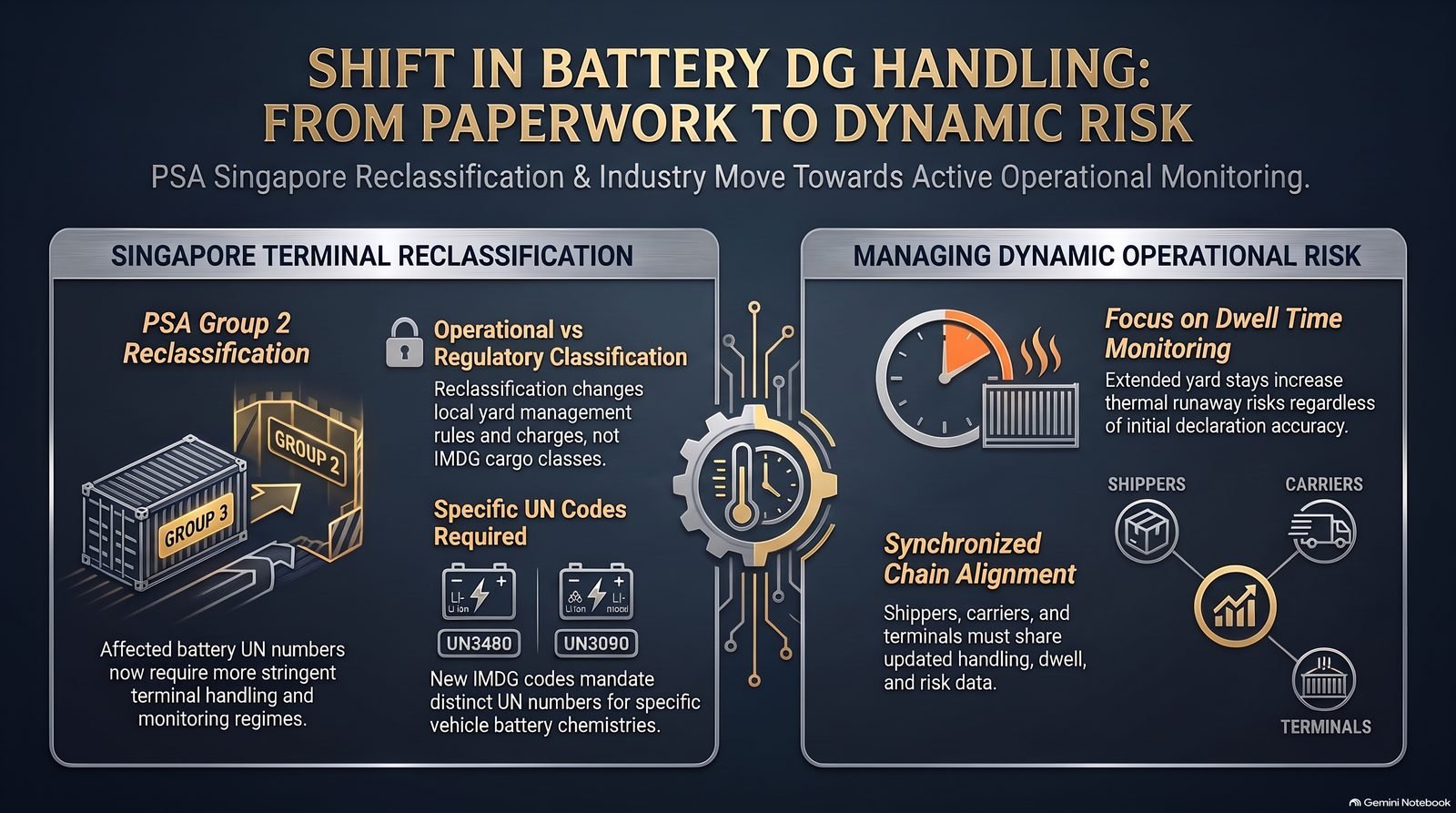
PSA Singapore has revised its terminal classification for a number of battery and battery-related dangerous goods.
The affected UN numbers include: UN3090, UN3091, UN3171, UN3480, UN3481, UN3536, UN3551, UN3552, UN3556, UN3557 and UN3558.
These have moved from PSA Group 3 to PSA Group 2, bringing them under a more stringent terminal handling regime.
And let’s clear up one important point straight away.
PSA Group 2 is not an IMO dangerous-goods classification. PSA hasn’t changed the IMDG Class of the cargo.
This is a terminal handling classification that affects how the cargo is managed within the PSA environment.
And that distinction matters.
So what actually changes?
For affected battery DG moving through Singapore, the change has consequences for things such as:
- terminal handling;
- segregation;
- yard arrangements;
- monitoring;
- dwell time; and
- applicable DG handling charges.
There are also mandatory monitoring requirements for designated battery DG shipments, particularly where prolonged dwell at the terminal is involved.
And that may be the more important part of the story.
Because the industry has traditionally been very good at asking:
“Was the cargo correctly declared?”
Perhaps we now need to ask:
“What happens to the risk after the cargo has been declared?”
A compliant container can still become a problem.
- The paperwork can be perfect.
- The declaration can be correct.
- The packing can comply.
- The container can be accepted.
- And something can still go wrong.
Battery behaviour doesn’t care how neatly the dangerous-goods declaration has been completed.
- Thermal runaway doesn’t check the manifest.
- A damaged cell doesn’t consult the booking system.
- And a container sitting in a yard for an extended period doesn’t become risk-free simply because it isn’t moving.
That is why the increasing emphasis on monitoring and dwell time is worth paying attention to.
The risk assessment is moving beyond: “What is in the box?”
towards: “What is happening to the box while it is in our care?”
Then there is UN3171.
This deserves particular attention. The 2024 IMDG Code incorporating amendment 42-24 became mandatory from 1 January 2026.
Among other changes, new entries were introduced for battery-powered vehicles:
- UN3556 – Vehicle, lithium-ion battery powered
- UN3557 – Vehicle, lithium metal battery powered
- UN3558 – Vehicle, sodium-ion battery powered
So the old habit of simply declaring an electric vehicle as UN3171 needs another look.
Because: “We’ve always declared it that way” is not a regulatory provision.
The battery chemistry and configuration now matter.
And yes, there is a bill.
The PSA Group change also has a commercial consequence.
Carriers have issued advisories concerning revised Dangerous Goods Handling Charges (DHT) and related charges for applicable Singapore transhipment cargo.
But frankly, the surcharge isn’t the most interesting part.
Money gets attention.
Risk deserves it first.
The Bigger Situation
This isn’t really about Singapore. Singapore is simply giving us a fairly clear glimpse of where the industry is heading.
Battery cargo is increasingly being treated as a dynamic operational risk, rather than simply a dangerous-goods documentation exercise.
The chain is becoming:
Correct classification.
Correct declaration.
Correct packing.
Correct handling.
Correct segregation.
Controlled dwell.
Monitoring.
Early intervention.
That’s a very different philosophy from: “The paperwork is correct. We’re good.”
TSM Situation Room Takeaway
Because the container doesn’t know what the paperwork says.
It only knows what’s happening inside it. And perhaps that is the real lesson here.
For decades, we have become very good at documenting cargo. Now we’re being forced to become equally good at managing what that cargo might do after the documentation is finished.
- The battery container may spend hours at a terminal.
- It may spend days.
- It may be transhipped.
- It may be delayed.
It may be exposed to conditions nobody planned for. And every additional hour is part of the operational story. The declaration tells us what we believe is inside the box. Monitoring tells us what is actually happening to it.
Maybe that’s the shift we should be paying attention to.
The maritime industry doesn’t usually run out of rules… We run out of attention.
— The Sarcastic Mariner(s)
Stirring the pot so the industry remembers how to think.
Previous Situation Room reports
The Situation Room. #15 – When the Mountain Cries
The Situation Room. #16 – The Combined Crisis Report
Next in the Situation Room: #18 – Boxships Are Burning →