
Dr. Kumud R. Jha · Singapore · Doctorate in AI · US Patent Holder View LinkedIn Profile
Inside the AI Data Economy: Why Nothing Is Actually Free
Let me start with something that sounds like a conspiracy theory but is simply corporate economics.
When you open Google, type a search, and get ten results back in 0.3 seconds — that is not free. That query ran across data centres consuming enough electricity to power a small household appliance. The servers, the cooling systems, the fibre optic cables, the thousands of engineers maintaining it all — that infrastructure costs money that would make your eyes water.
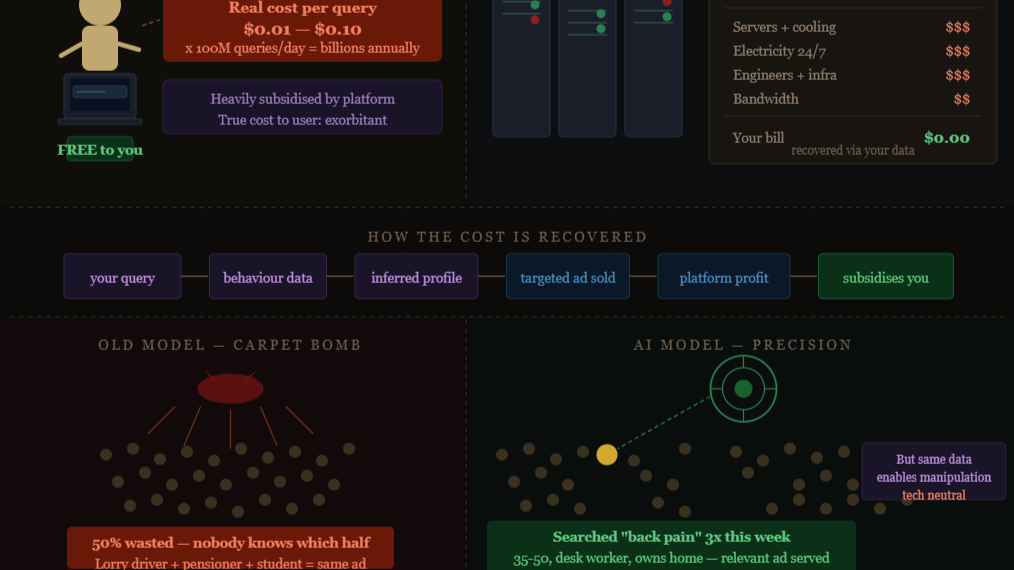
A single ChatGPT query costs OpenAI somewhere between $0.01 and $0.10 to process depending on its complexity. Multiply that by the 100 million queries the platform handles daily and you are looking at operational costs that run into the billions annually — before a single engineer is paid or a single server is purchased.
You pay nothing. So who pays?
The answer is: the companies pay — and then they recover that cost, with considerable profit, through you. Not through your wallet. Through your data, your attention, and your behaviour.
Here is how the arithmetic works. You search for “lower back pain” on Google. That query, combined with your location, your search history, your device, the time of day, and a thousand other signals, tells an advertiser that you are probably between 35 and 55, likely sedentary, possibly in a white-collar job, and currently experiencing a health issue that might make you receptive to ergonomic furniture, physiotherapy services, or over-the-counter pain medication.
The advertiser does not pay to show their ad to everyone. They pay to show it to you, specifically, right now. That precision is worth an enormous premium over the old model — the billboard on the motorway that showed the same message to a lorry driver, a pensioner, a student, and a marketing director with equal indifference to whether any of them were in the market.
This is the bargain. And it is worth understanding clearly before you decide how you feel about it.
Before targeted advertising, marketing was a spectacular waste. The old rule of thumb in the industry — attributed variously to several advertising legends — was that half of all advertising spending was wasted. The problem was that nobody knew which half. A car manufacturer would spend millions on television commercials that reached millions of people who had no intention of buying a car, no access to credit, or had just purchased one six months ago.
Targeted AI-powered advertising does not eliminate waste entirely — nothing does. But it reduces it dramatically. The person who sees the physiotherapy ad actually has back pain. The person who sees the mortgage refinancing offer actually owns a home and has been searching refinancing terms. The person who sees the MBA programme ad actually works in finance and has been reading career development articles.
From the advertiser’s perspective, this is more efficient. From the consumer’s perspective — and this is the part that often gets lost — it can also be more relevant. Most people, if honest, would prefer to see an ad for something they might actually want over an ad for something entirely irrelevant to their lives.
But here is where it becomes genuinely complicated — and where the concern is legitimate.
The same data infrastructure that makes advertising more relevant also enables manipulation. The difference between “showing you something you might want” and “exploiting your psychological vulnerabilities to make you want something you do not need” is a line that the industry crosses regularly and deliberately.
The same signals that help a physiotherapy clinic reach someone with back pain help a payday lender target someone in financial distress. The same behavioural inference that surfaces a relevant product can also surface politically divisive content because outrage keeps people on the platform longer. The same system that makes advertising more efficient can, at its worst, become a machine for manufacturing desire, deepening addiction, and amplifying anxiety.
The technology is neutral. The incentive structure is not.
So what does this mean practically?
Your data has two faces. One is genuinely useful — to you, to researchers, to services that can personalise and improve because they know something about what you actually need. The other is a commodity that is bought, sold, inferred, and deployed in ways you cannot see and often could not consent to meaningfully even if the option were offered.
This is the same infrastructure we looked at in AI surveillance and the data trade — except here, the question isn’t who’s watching, but who’s profiting.
The bargain you made — free services in exchange for your data and attention — was never explained to you at the moment you made it. The terms were buried in a privacy policy that nobody reads, written by lawyers to minimise liability rather than inform users.
This is not a reason to panic. It is a reason to be awake.
Know that the free AI tool you use costs real money to run — and someone is paying for it with your data. Know that your data is more valuable aggregated than alone — and that its value flows almost entirely to the platform, not to you. Know that targeted advertising is a better deal than carpet-bombing for both sides — but that the same infrastructure has uses that go well beyond showing you relevant products.
And know that regulations — GDPR in Europe, emerging frameworks in India, California’s CCPA, and a dozen others — are beginning to require that some of the value your data generates flows back toward your rights, your consent, and eventually, perhaps, your pocket.
The transaction is not inherently evil. But it should be informed.