
Dr. Kumud R. Jha · Singapore · Doctorate in AI · US Patent Holder View LinkedIn Profile
Let me give you a number that should trouble every one of us.
There are approximately 4.5 million doctors in the world. The global population is 8.1 billion.
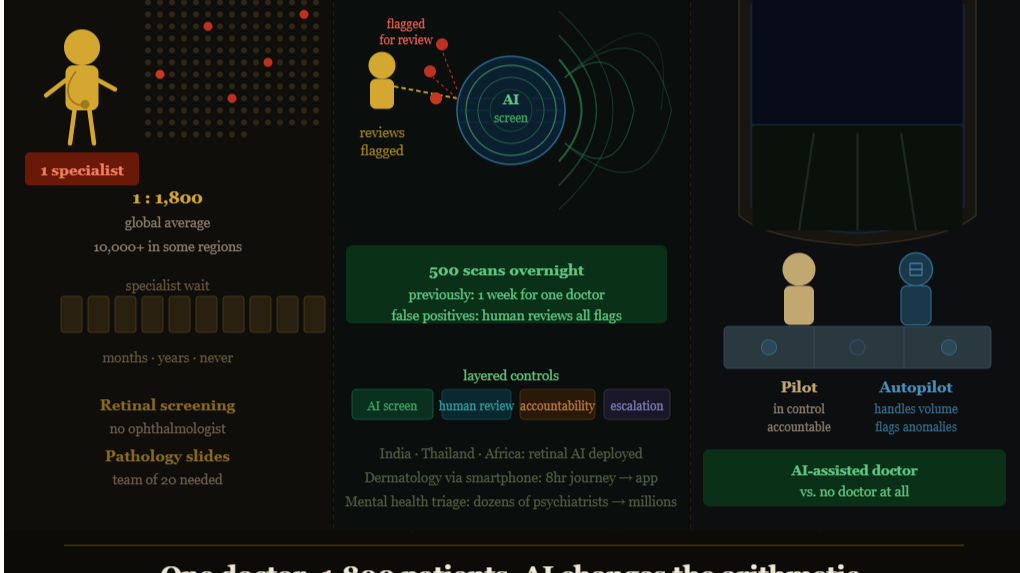
That is one doctor for every 1,800 people — and that average conceals something far more alarming. This is the scarcity gap that AI in healthcare is now uniquely positioned to close. In sub-Saharan Africa, some countries have fewer than one doctor per 10,000 people. In rural India, a specialist — a cardiologist, an oncologist, a radiologist — may be the only one serving a region the size of a small European country. In conflict zones and remote archipelagos, there may be no specialist at all.
The scarcity is not a matter of training enough people. Training a specialist takes 12 to 15 years. You cannot solve a crisis that is happening today with doctors who will qualify in 2038.
This is where AI enters — not as a replacement, but as a force multiplier.
Consider what happens when a single radiologist in a regional hospital in rural Kenya can use an AI diagnostic tool to screen 500 chest X-rays overnight — flagging the ones that need urgent human review, triaging the rest by priority, and catching patterns that fatigue or volume might cause a human to miss. The radiologist does not disappear. She becomes more powerful. This is the same “co-pilot, not replacement” argument we made about AI and job loss — the technology doesn’t erase the human, it changes what the human’s time is spent on. She can do in a night what previously took a week. And the patients who had no radiologist at all now have access, through her amplified capacity, to something approaching specialist-level screening.
This is already happening. In diabetic retinopathy screening — a leading cause of preventable blindness — AI systems have been deployed in rural clinics across India, Thailand, and parts of Africa where ophthalmologists are simply not available. The AI screens. A remote specialist reviews the flagged cases. Patients who would have gone blind from a condition that is entirely preventable now receive intervention.
In pathology, AI tools are helping a handful of pathologists process slides at a scale that would previously have required teams of twenty. In dermatology, AI screening tools deployed via smartphone are reaching patients in communities where the nearest dermatologist is an eight-hour journey away. In mental health, AI-assisted triage is helping community health workers — with no clinical training — identify which patients need urgent escalation, in countries where psychiatrists number in the dozens for populations in the tens of millions.
The scarcity problem in healthcare is one of the most devastating inequalities on earth. AI is the first technology with a realistic prospect of addressing it at scale.
But — and this is a non-negotiable but.
AI diagnostic tools produce false positives. They flag conditions that are not there. They occasionally miss conditions that are. The error rate varies by tool, by population, by image quality, by the data the model was trained on. These are not theoretical concerns. They are documented, studied, and actively addressed — but not yet solved.
This means the answer is not “deploy AI and stand back.” The answer is layered. AI as the first screen. Human clinical judgement as the review layer. Robust escalation pathways for anything the AI flags. Clear accountability for the decisions that follow.
Think of it as the aviation model. The autopilot flies the plane with extraordinary precision and consistency. It handles the long, stable cruise where human attention naturally drifts. But the pilot is present, trained, legally responsible, and in full control at every moment of consequence — takeoff, landing, turbulence, anything anomalous. Nobody suggests that autopilot makes pilots redundant. It makes them more effective and frees their attention for what matters most.
AI in healthcare works the same way. The AI handles volume. The specialist handles complexity, context, consequence, and accountability.
The alternative is not “AI versus the doctor.” The alternative is “AI-assisted doctor versus no doctor at all.”
In that framing, the choice is not difficult.
For the child in a rural district with no cardiologist within three hundred kilometres, an AI that can screen her ECG and flag an anomaly for remote review is not a risk. It is, quite possibly, the difference between a diagnosis and a funeral.
The controls must be real. The accountability must be clear. The human must remain in the loop. These are not optional conditions — they are the architecture that makes the technology trustworthy.
But let us not allow the perfect to become the enemy of the life-saving.