
Dr. Kumud R. Jha · Singapore · Doctorate in AI · US Patent Holder View LinkedIn Profile
Five days ago I showed you AI as a cracked mirror — reflecting society’s past inequalities back at us. Today I want to go one level deeper.
The real question is: “So who is responsible?” That question — the one of AI accountability — is where today’s piece picks up.
Today I want to go one level deeper.
Because the question I get asked most often isn’t “is AI biased?” — people accept that now. The real question is: “So who is responsible?”
Here is what most people get wrong: they think of AI bias as a bug. Something that crept in accidentally, that engineers will eventually patch out.
It isn’t a bug. It is an inheritance.
When Amazon’s hiring algorithm downgraded CVs containing the word “women’s” — as in “women’s chess club” — it wasn’t making a mistake. It was faithfully learning from 10 years of hiring decisions made by humans. The data was a perfect record of the past. The algorithm was a perfect student.
This changes everything about where we look for solutions.
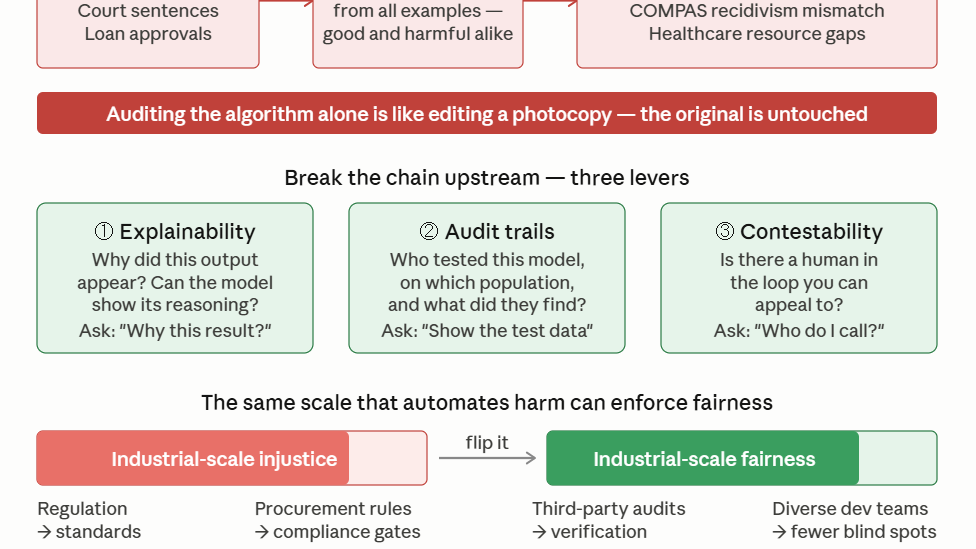
Auditing the algorithm alone is like editing a photocopy while leaving the original untouched. The work has to go upstream — into the data, the problem framing, the team composition, the incentive structure of whoever commissioned the system.
Three things you can demand as a user or a decision-maker:
- Explainability — why did this system produce this output?
- Audit trails — who tested this, on what population, and what did they find?
- Contestability — is there a human in the loop I can appeal to?
AI doesn’t manufacture injustice. But it can automate it at industrial scale.
The good news: industrial-scale problems have industrial-scale levers. Regulation, procurement standards, third-party auditing, and diverse development teams are all pulling in the right direction.
You don’t have to be a data scientist to ask the right questions. You just have to know what questions are worth asking.