
Dr. Kumud R. Jha · Singapore · Doctorate in AI · US Patent Holder View LinkedIn Profile
Let me ask you something before we start.
Has anyone ever sent you a message — a video, an article, a voice note — that made an argument so compelling, so well-structured, so apparently evidence-based, that you almost believed it? And then, when you looked closer, you realised that about 80% of it was accurate and the remaining 20% was quietly, carefully wrong?
That is the architecture of the most effective misinformation ever produced. Not the blatant lie — which most people catch. But the sophisticated blend. The argument that earns your trust with genuine facts and then, once it has that trust, uses it to smuggle in the conclusion the author always wanted you to reach.
The moon landing. The flat earth. Vaccine conspiracies. Anti-climate science.
These are not believed by unintelligent people. They are believed by people who encountered arguments that were 80% scientifically grounded, carefully cited, and internally consistent — with 20% quietly fabricated, misrepresented, or taken grotesquely out of context. The fabricated 20% is where the payload lives. Everything else is the delivery vehicle.
The moon landing deniers will show you genuine photographs with authentic shadows and argue convincingly about light angles — before telling you the shadows are wrong. They will cite real physics before reaching a conclusion that real physics does not support. The flat earthers will use genuine observations about the horizon and the human eye’s limits — before ignoring the mathematics that explains exactly why the earth appears flat at ground level even though it is not.
The skill required to resist this is not a high IQ. It is not a science degree. It is something simpler and more democratic: the habit of asking “what is the one thing in this argument that I cannot verify — and why is it the thing the author most wants me to accept?”
Wheat from the chaff. Most humans are better at this than they believe, and considerably better at it than the fearmongers about AI literacy would have you think.
And here is why this matters directly for AI.
AI systems produce outputs that follow exactly this pattern. They are overwhelmingly accurate — and occasionally, confidently wrong. They blend verified information with plausible-sounding fabrication so smoothly that the join is invisible without scrutiny. The technical term is hallucination. The practical effect is the 80/20 lie, generated at machine speed.
This sounds terrifying until you realise that the same critical faculty — the same wheat-from-chaff instinct — that protects you from moon landing deniers is exactly what protects you from AI hallucinations. You do not need to understand transformer architectures. You need to apply the same healthy scepticism to AI outputs that a thoughtful person applies to a forwarded WhatsApp message.
Does this claim sound too clean? Is this exactly what I was hoping to hear? Can I verify the one thing I cannot verify? Is the source cited actually saying what the AI claims it says?
These questions are not technically demanding. They are habits of mind. And they transfer directly from navigating misinformation to navigating AI.
But the deeper argument I want to make today is about the car.
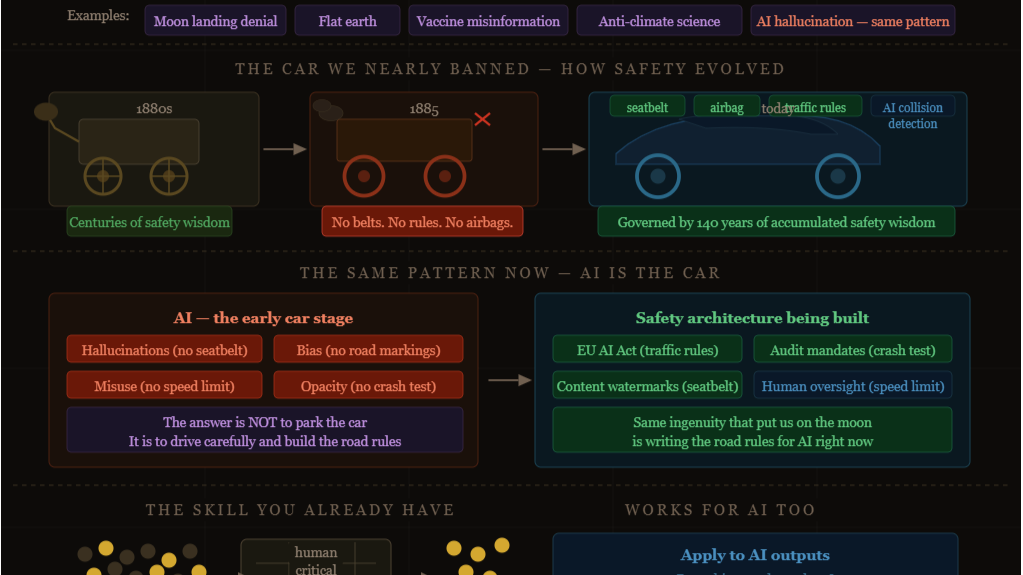
When Karl Benz built the first petrol-powered automobile in 1885, it was, by any modern standard, a death trap. No seat belts. No airbags. No traffic lights. No road markings. No speed limits. No highway code. No crash testing standards. No driving licences in most places.
The result was predictable. Early motor vehicles killed people at a rate that would be considered an outrage today. A horse and cart, for all its limitations, had centuries of accumulated safety wisdom built into its use. The car had none. And the reasonable, evidence-based argument at the time was: this technology is demonstrably more dangerous than what it replaces. We should not adopt it.
That argument was technically correct and strategically catastrophic. It’s the same instinct we examined in why AI isn’t about to take over — a real, ancient fear response colliding with a technology that doesn’t yet warrant it at that scale.
Because what followed was not the abandonment of the car. What followed was the invention of everything that made the car safe. Traffic rules. Speed limits. Driving tests. Seatbelts — which cars were required to have fitted from 1968, though wearing one wasn’t legally mandatory in the UK until 1983. Airbags. Crash barriers. Pedestrian crossings. Road markings. Vehicle safety standards. Anti-lock brakes. Crumple zones. And now, remarkably, AI-powered collision detection systems that the original safety campaigners could not have imagined.
The car did not become safe because we waited until it was safe to adopt it. It became safe because we adopted it, encountered its dangers, and built the governance architecture around it over generations.
AI is the car. The hallucinations are the lack of a seatbelt. The misinformation risk is the absence of a speed limit. And we are living through the moment when the road rules are being written.
The answer is not to park the car. The answer is to drive carefully, demand better roads, insist on safety standards, and trust that the same human ingenuity that put a person on the moon — and yes, we absolutely did go to the moon — will figure out the governance of this technology too.
The wheat-from-chaff skill. The seatbelt instinct. The traffic rule habit.
These are not technological capabilities. They are human ones. And we already have them.