
Dr. Kumud R. Jha · Singapore · Doctorate in AI · US Patent Holder View LinkedIn Profile
What AI Without Fear Was Always About
We made it. Thirty days. Thirty posts. One idea, examined from every angle I could find.
AI without fear was never really about AI. It was about fear — and what happens when you replace fear with understanding.
Let me say what I actually believe — after a doctorate in AI, nearly two decades in energy strategy, and thirty days of forcing myself to articulate the most honest version of every argument I could construct.
AI is not the story. The story is us. What we value. What we build. What we refuse to accept. What we demand of the systems we create and the institutions that govern them. What we choose to protect — in our organisations, in our democracies, in our children’s futures, in ourselves.
AI is a mirror. An amplifier. A lever of extraordinary power. But it has no agenda of its own. Every agenda it serves is a human one.
That is not reassuring in a simple way. It is reassuring in the only way that matters — because it means the outcome is not predetermined. The future is genuinely open. And open futures are the only kind worth having.
What Thirty Days Taught Me About How People Actually Think About AI
Most people are not afraid of the technology. They are afraid of being left behind by it — of a world reorganising itself around capabilities they do not have and decisions being made without them. That fear is rational. And the answer to it is not reassurance. It is participation.
Most people, when given honest information without agenda, are more capable of nuanced thinking about AI than the loudest voices in the room give them credit for. The public conversation about AI is not too complex for ordinary people. It is being conducted, largely, without them.
And most people — this is the thing that has moved me most across thirty days of conversation — genuinely want the technology to go well. Not just for themselves. For everyone. That instinct is not naive. It is the foundation of every good outcome this technology could produce.
What I Hope You Take From These Thirty Days
Not a position on AI. Positions change as facts change, and the facts will keep changing faster than anyone can track.
What I hope you take is a practice. The practice of asking: what is actually true here, as opposed to what is being claimed? The practice of distinguishing between a risk that is real and a risk that is being amplified for someone else’s purposes. The practice of looking for the humans behind the systems — the choices, the incentives, the accountabilities. The practice of demanding more: more transparency, more oversight, more honesty about costs and tradeoffs.
And the practice of staying in the conversation. Not because you have all the answers. Because your presence in the conversation is itself consequential.
A few things I know for certain. The people working to make AI safe and beneficial are real, serious, and deserve more support than they get. The risks are real and the governance is genuinely insufficient — but both of those things are true of every powerful technology in its early decades, and the response is engagement, not despair.
The most important question in AI is not technical. It is: what kind of world do we want, and does this technology move us toward or away from it? That question belongs to everyone.
And the people most capable of answering it well are not the ones who are most afraid of the technology — or the ones who are most uncritically enthusiastic about it. They are the ones who have done the work to understand it honestly, hold its contradictions without flinching, and act from that understanding.
That is what AI without fear was always about. Not the absence of concern. The presence of clarity.
Thank You
To everyone who read a post, shared one, pushed back on one, or simply stayed curious for thirty days — thank you. You are the reason this was worth doing.
📚 The Series
Series Intro — AI Without Fear: A 30-Day Challenge to Understand AI Without the Panic
Day 1 — Job Loss & Automation
Day 2 — Misinformation & Deepfakes
Day 3 — Privacy & Surveillance
Day 4 — AI Bias & Fairness
Day 5 — AI Taking Over Humanity
Day 6 — AI as Co-Pilot, Not Captain
Day 7 — You Are Not the Customer. You Are the Asset.
Day 8 — The 80/20 Lie and the Car We Nearly Banned
Day 9 — AI Bias & Fairness: Beyond the Mirror
Day 10 — AI Taking Over Humanity: Who Is Actually in Charge?
Day 11 — AI and Jobs: This Time Is Different. Here Is Why That Is Not the End of the Story.
Day 12 — AI & Privacy: You Are Not Powerless
Day 13 — AI & Creativity: What Authorship Means Now
Day 14 — AI & Misinformation: Who Decides What Is Real?
Day 15 — Halfway There: Here Is What We Have Learned Together
Day 16 — Using AI Well: The Skill Nobody Is Teaching
Day 17 — AI Literacy: What It Actually Looks Like on a Tuesday
Day 18 — Emerging AI Skills: What the Next Five Years Actually Reward
Day 19 — AI Leadership: What It Means to Lead Now
Day 20 — Future-Proof Career Skills: What Actually Survives Automation
Day 21 — Learning Architecture: How to Upgrade Yourself Before You Need To
Day 22 — AI Adoption Strategy: Why Deliberate Beats Fast
Day 23 — AI Equity: The Widening Gap Nobody Is Talking About
Day 24 — AI’s Carbon Footprint: The Cost Nobody Puts on the Invoice
Day 25 — AI Trust: How Do You Trust What You Cannot Fully Understand?
Day 26 — AI and Democracy: When the Town Square Becomes a Hall of Mirrors
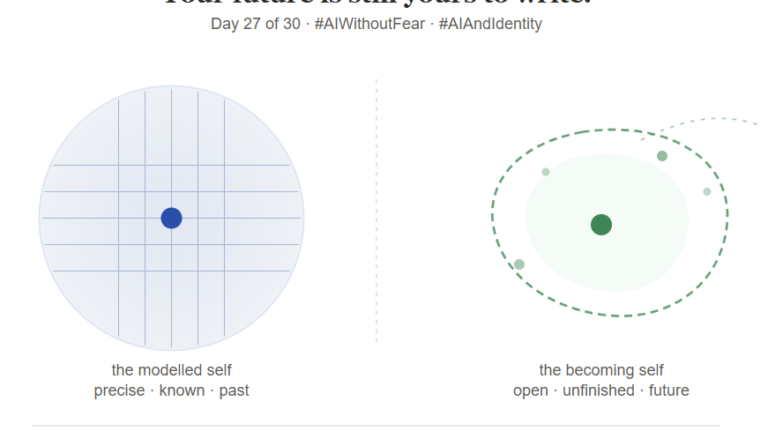
Day 27 — AI and Identity: Who Are You When the Machine Knows You Better Than You Do?
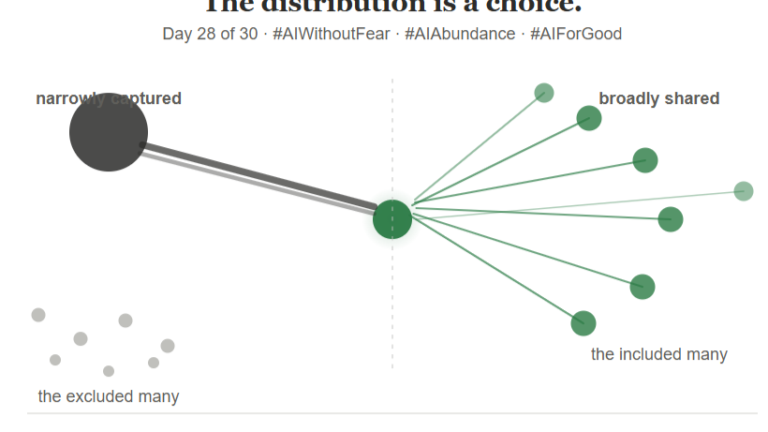
Day 28 — AI Abundance: The Question We Are Not Asking Loudly Enough
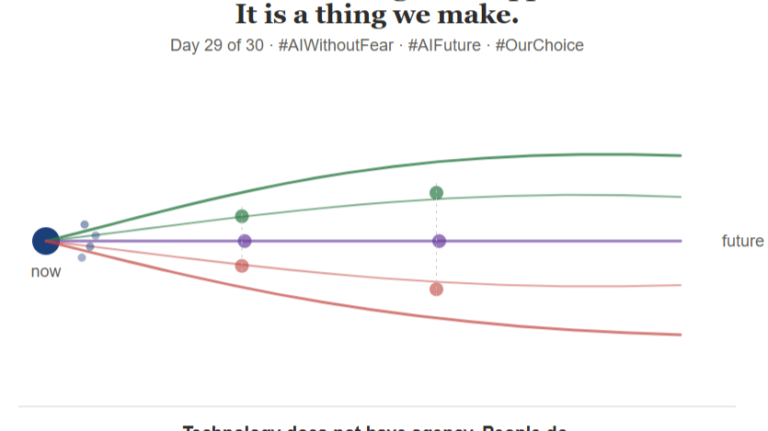
Day 29 — The Future of AI Is Not What AI Will Do. It Is What We Will Choose.
Day 30 — Thirty Days. What It Actually Means. (this post)
Thirty days. One idea. Thank you for reading.